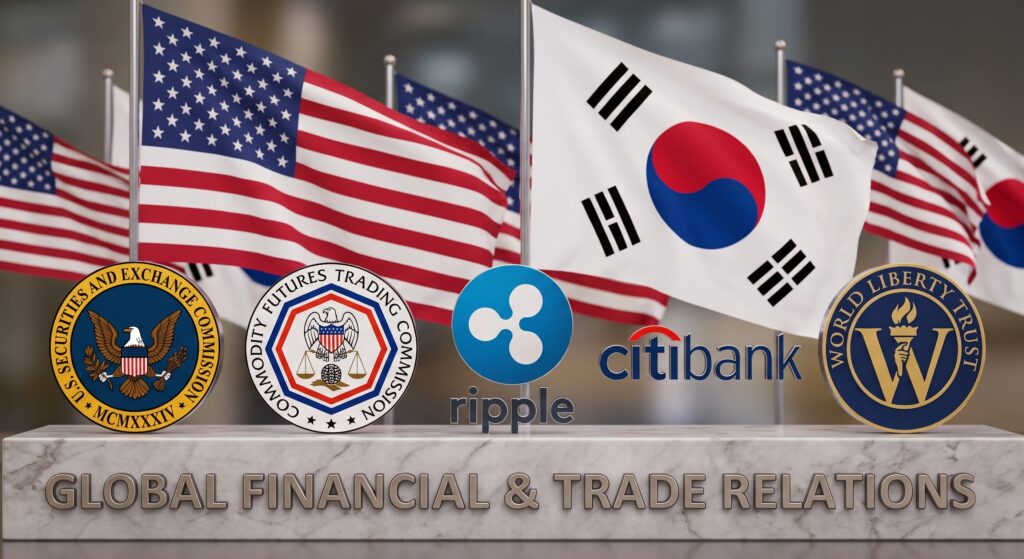
Federal agencies in the U.S. are setting administrative rules for digital asset capital
raising and stablecoins while Congress is in recess.
Major financial institutions are expanding infrastructure: Citi is adding digital assets to
its global custody platform, the OCC granted conditional trust bank approval to World
Liberty Trust, and Jeonbuk Bank integrated Ripple’s payment system in South Korea.
Federal Agencies Advance Parallel Crypto Rules Amid Stalled Senate Legislation
The Trump administration has shifted toward executive rulemaking to establish digital
asset operating frameworks, coordinating agency actions across the SEC, CFTC, and Treasury.
Under the proposed Regulation Crypto Assets, the SEC introduced specific safe harbors
for crypto offerings while defining federal standards that override state-level registration
requirements. The Treasury Department’s GENIUS Act rulemaking frames dollar-backed
stablecoins as regulated payment infrastructure, establishing standardized federal
issuance definitions ahead of its 2027 implementation date. Traditional market
infrastructure operators, including Nasdaq, NYSE, CME Group, and DTCC, joined
crypto-native firms at an August 19 White House meeting to address onchain
tokenization and market structure. The CFTC’s inaugural Innovation Advisory
Committee session further establishes formal agency review tracks for tokenized real-
world assets and event contracts alongside legislative processes.
Blockchain Association Backs SEC Proposal to Rescind Legacy Trading Rules
The Blockchain Association submitted a comment letter supporting the Securities and
Exchange Commission’s June proposal to repeal Rules 611 and 610(e) under Regulation
NMS. Adopted in 2005, these rules aimed to prevent trade-throughs and manage market
access, but the SEC and industry advocates now state they generate unnecessary costs
and add market complexity.
The trade group contends that the legacy framework constrains the development of
public blockchain infrastructure for tokenized traditional financial assets.
In its submission, the association urged regulators to recognize onchain execution
mechanisms as compliant standards for fair and efficient execution.
The public comment period closed on Monday, and the SEC has not yet issued a final
ruling on the proposed repeal.
Citi Integrates Digital Assets and 24/7 Tokenized Settlement into Core Custody
ArchitectureCiti Investor Services has launched Custody+ to provide near- and real-time asset
servicing, with plans to go live with Bitcoin custody later this year under a unified
institutional framework. The architecture allows clients to access crypto custody
alongside traditional asset servicing, backed by Citi Token Services for continuous 24/7
movement of tokenized deposits. The framework complements existing onchain
initiatives, such as Citi’s launch of tokenized depositary receipts for private equity
shares in partnership with Swiss market infrastructure provider SIX. Operationally, the
system utilizes single event processing to eliminate processing latency, providing
instant cash position updates, automated FX hedging, and direct API cloud connectivity.
Regulatory considerations under U.S. SEC and OCC guidance continue to define
institutional safeguards for bank-administered digital asset custody and onchain
trading infrastructure.
World Liberty Trust Gains Conditional OCC Approval as USD1 Integrates with AI Platforms
The Office of the Comptroller of the Currency conditionally approved World Liberty Trust
Co.’s application for a national trust bank charter to directly manage and issue its USD1
stablecoin under federal supervision.
DT Marks DEFI LLC, affiliated with President Donald Trump and his family, holds a 38%
stake in the entity controlling World Liberty Financial along with 22.5 billion governance
tokens, with disclosures showing nearly $600 million in token and equity sales in 2025.
In parallel, independent AI aggregator WorldClaw, which reports processing over 50
million daily task requests across 10,000 users, accepts USD1 payments for its
software services.
WorldClaw offers access to 90 AI models, including U.S. platforms and 43 models
developed by Chinese technology firms, with USD1 reserves held in assets such as U.S.
Treasury securities to back token redemptions.
Jeonbuk Bank Partners with Ripple to Deploy Cross-Border Payment Infrastructure
South Korea’s Jeonbuk Bank has partnered with Ripple to deploy Ripple Payments,
aiming to provide 24/7 cross-border settlement infrastructure for corporate clients as
an alternative to traditional SWIFT transfers that process through multiple intermediary
banks.
The proposed deployment is designed to enable near real-time settlement completed in
seconds to minutes for import-export firms, IT startups, and online content creators.
As the first Korean regional bank partnering to deploy this framework, Jeonbuk Bank
joins Kyobo Life Insurance and KBank in Ripple’s institutional engagement within South Korea.
The broader institutional scope in the country spans tokenized government bond
settlement, wallet-as-a-service infrastructure, and cross-border payment testing.
This institutional expansion develops structural digital asset capabilities for corporate
treasury functions alongside broader market activity.
with thanks to Dean Shuker & Aviv Barkan for their research and fact checking.